REVIEW · GOA
4-Day Private Golden Triangle Tour: Delhi, Agra, and Jaipur
Book on Viator →Operated by Pacific Classic Tours India · Bookable on Viator
Golden Triangle, minus the stress. I like the private guides who explain what you’re looking at, and I love the early-timed Taj Mahal plan that helps you dodge both crowds and heat. You get a smooth route with an air-conditioned vehicle and entry fees covered for the main sights.
One thing to weigh: the sunrise Taj Mahal visit depends on clear weather, and meals beyond hotel breakfast are not included. If you want a quick add-on like the Amber Fort jeep ride, there can be an extra cost.
In This Review
- Key highlights worth your attention
- Golden Triangle, planned like a route (not a scramble)
- Price and what you really get for $388
- Day 1: Fly into Delhi, drive to Agra, and see the Taj Twice
- Mehtab Bagh photo tour (evening)
- Day 2: Sunrise Taj Mahal, Agra Fort, then Jaipur’s Pink City
- Sunrise Taj Mahal (early morning)
- Agra Fort
- Drive to Jaipur
- Day 3: Amber Fort and Jaipur’s big sights, with smart photo stops
- Amber Fort
- Jal Mahal photo stop
- Hawa Mahal photo stop
- City Palace and Jantar Mantar
- Back to Delhi
- Day 4: Mughal tombs, Qutub Minar, Lotus Temple calm, and Lutyens Delhi
- Humayun’s Tomb
- Qutub Minar
- Lotus Temple
- India Gate, Parliament area, and Rashtrapati Bhavan area
- Drop-off
- The Taj Mahal timing trick: crowds, heat, and weather
- Guides make it feel personal, not generic
- Comfort, transport, and the reality of long drives
- Who should book this Golden Triangle plan
- Should you book this 4-day private Golden Triangle tour?
- FAQ
- What’s included in the tour price?
- Does this tour include hotel stays and breakfast?
- Do I need to arrange my own domestic flights?
- Are meals included besides breakfast?
- Is the Taj Mahal sunrise visit guaranteed?
- Is the jeep ride at Amber Palace included?
Key highlights worth your attention
- Private, local guides in every city, so you’re not just collecting photos
- Taj Mahal at sunrise plus a second Taj photo option from Mehtab Bagh
- Entry fees included for the sights on the program (big value here)
- Air-conditioned private vehicle for the long drives between Delhi, Agra, and Jaipur
- Battery bus/golf cart return from the Taj Mahal parking area
- Plenty of photo stops (Jal Mahal, Hawa Mahal) without turning your day into a marathon
Golden Triangle, planned like a route (not a scramble)
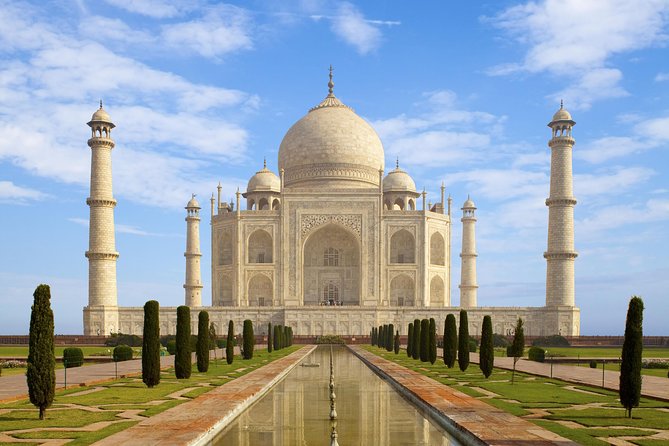
This 4-day Golden Triangle tour is built around one simple idea: seeing the big names without burning your whole trip fighting traffic, finding tickets, and guessing where to go next. You start in the Delhi area, then push west to Agra for the Taj Mahal, and finally swing into Jaipur for forts, palaces, and the kind of architecture that makes you stop walking just to stare.
The biggest value is how the day flow is structured. You’re up early for the Taj Mahal, you get an evening photo tour option, and you keep moving with local context in each city. That combination matters in India, where sight lines, opening times, and crowd patterns can change fast.
And yes, it’s still a lot. Four days in three cities means packed schedules, mostly because these places are spread out. The upside is you’ll get a strong first pass at Delhi, Agra, and Jaipur without wasting days on logistics.
You can also read our reviews of more private tours in Goa



Price and what you really get for $388
At $388 per person, this tour can feel like a deal because it includes more than the basics. You’re not just paying for a car and a driver. You also get professional local private tour guides and entry fees for the sights specifically listed in the itinerary. That can add up quickly when you’re stacking UNESCO-level sites back-to-back.
Also included are unlimited bottled water and a return ride by battery bus/golf cart from Taj Mahal parking. Those little details reduce friction, especially on a day when you’re already up early.
What’s not included is equally important. You’ll need to cover domestic flights if you’re arriving in Delhi by air from elsewhere, and meals and drinks are not included aside from breakfast when you choose the hotel option. If you’re the type who likes lunch stops every few hours, budget for it.
The overall value depends on your travel style:
- If you want a guided plan with major entrances handled, the price makes sense.
- If you’re comfortable self-navigating and eating on your own, you might compare other options, but you’d likely lose the included guidance and entry fees.
Day 1: Fly into Delhi, drive to Agra, and see the Taj Twice
Your day starts early, with pickup around 8:00 am from a long list of Indian cities. The idea is simple: you head to your local airport, then connect to New Delhi. Once you arrive, you’re met and driven about 3 hours to Agra via express highway.
In Agra, you check into your pre-booked hotel and settle in. Then the sightseeing tone shifts to a classic two-part approach: the “moonlit” Taj photo plan comes first, not second.
Mehtab Bagh photo tour (evening)
You go to Mehtab Bagh, often described as the moonlit garden. It’s a smart move for first-timers because the timing can feel calmer than midday. You’re there specifically for a photo tour of the Taj Mahal from across the river, away from the most intense crowd zones.
This is one of those experiences that’s less about ticking boxes and more about changing the angle. The Taj isn’t just one view, and by day one you’ll start noticing that.
One consideration: if you’re hoping for a perfectly scheduled sunrise later, keep in mind the real weather depends on conditions. (More on that in the Taj section.)
Day 2: Sunrise Taj Mahal, Agra Fort, then Jaipur’s Pink City
Day 2 is the core day for Agra.





Sunrise Taj Mahal (early morning)
You head out at sunrise to see the Taj Mahal, a UNESCO World Heritage Site. The whole point is to avoid the harsh daytime heat and the peak crowd swell. You get about two hours at the site, which is enough time to slow down, look at details, and still not feel rushed out the door.
If the Taj is your top priority, this is the part of the trip that justifies the tour format. Seeing it in the early light changes the atmosphere. Stone looks different at different hours, and morning light tends to give you that softer contrast you don’t get later.
Agra Fort
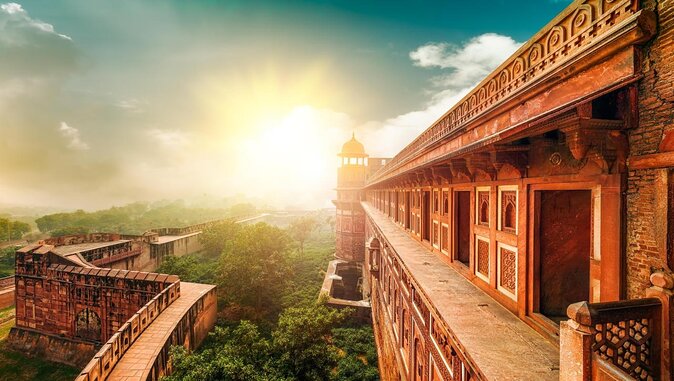
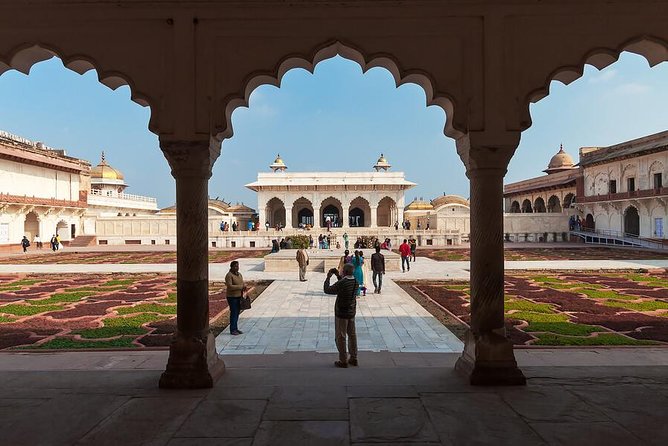
After the Taj, you visit Agra Fort for about one hour. It’s also UNESCO-listed and sits along the Yamuna River. The focus here is Mughal-era power and the fort as a residence space—where emperors lived and ruled.
Agra Fort pairs well with the Taj because it helps you connect the monument to the era that created it. Without that context, it’s easy to treat the Taj as a stand-alone masterpiece.
Drive to Jaipur
Later you drive to Jaipur, the Pink City. You check into your hotel and get a longer stretch for arrival time and settling in—about five hours accounted for on the day.
For many people, Jaipur feels like a mood switch from the river city stone monuments to Rajasthan’s forts and palace architecture.
Day 3: Amber Fort and Jaipur’s big sights, with smart photo stops
Day 3 is where Jaipur hits you in layers.
Amber Fort
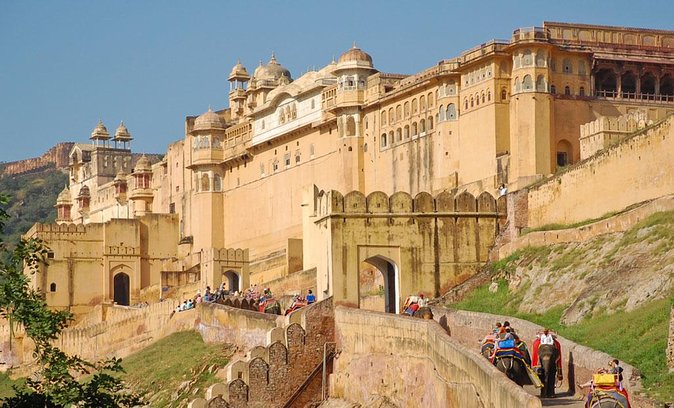
The highlight is Amber Fort (often pronounced amer). You spend around two hours, and this is a serious architecture moment. The fort rises from a rocky hillside about 11 km northeast of the city, and you get an approach that feels grand even before you reach the main areas.
There’s one optional extra to know about: the jeep ride at Amber Palace is not included. It’s listed as $3 per person and is applicable for 5 and above travelers. If your group is smaller, you might just plan for the standard access route.
Jal Mahal photo stop
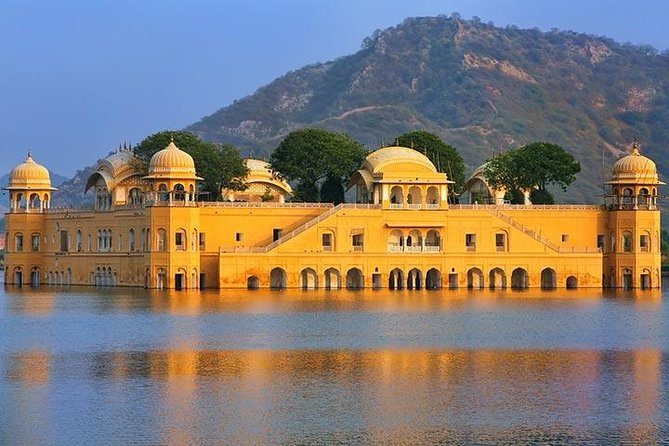
Next you get a quick photo stop at Jal Mahal, the Water Palace, with its placement in the Man Sagar water setting. It’s not a long visit. The value is the quick visual hit: you see the palace’s unusual relationship with water, then move on.
Hawa Mahal photo stop
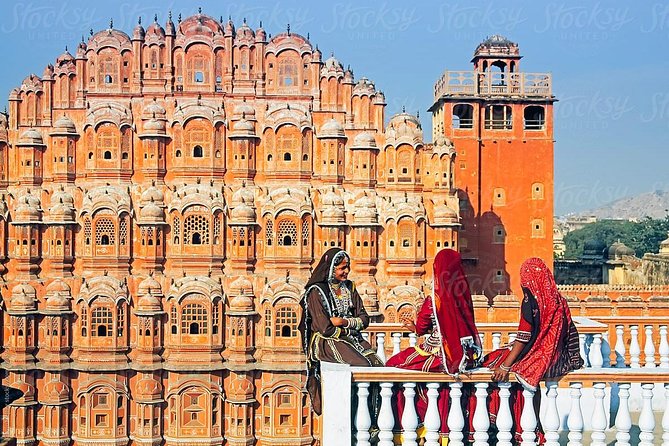
Then there’s Hawa Mahal (Palace of the Winds) as a photo stop for about 15 minutes. It’s one of Jaipur’s most recognizable facades—five storeys of pink and honeycomb-like openings. It’s included as a photo stop, and it’s listed as admission not included for this part, so you’re not paying extra to stand inside.
City Palace and Jantar Mantar
You continue to City Palace, the royal family residence complex, with about one hour there. City Palace works because it’s not a single building. It’s a mix of courtyards and structures across eras, so you get an evolving sense of Jaipur’s royal story.
After that comes Jantar Mantar, the observatory with geometric structures used to track star and planet movements. It’s UNESCO-listed and gets about one hour.
This pairing is smart: Amber Fort gives you fort power and Rajasthan architecture. City Palace gives you royal life spaces. Jantar Mantar gives you the science side. One day, three different “why Jaipur matters” angles.
Back to Delhi
At the end of the day, you drive back to Delhi and check into your hotel. Jaipur to Delhi takes time, and this is where the air-conditioned vehicle matters most.
Day 4: Mughal tombs, Qutub Minar, Lotus Temple calm, and Lutyens Delhi
Your final day is a highlight loop through old Delhi and New Delhi-style monumental planning.
Humayun’s Tomb
After breakfast, you visit Humayun’s Tomb, another UNESCO World Heritage Site. The key thing here is the arched facade with white marble inlaid bands and red sandstone. It’s a Mughal-era statement, and seeing it on the last day helps you compare it with Agra’s Mughal landmarks.
Qutub Minar
Next is Qutub Minar, also UNESCO-listed. It’s described as an Afghan-style victory tower and minaret, erected in 1193. You get about one hour here, enough time to appreciate the scale and details without feeling stuck at just one corner.
Lotus Temple
Then you shift into modern spiritual calm at the Lotus Temple. It’s shaped like a lotus flower with 27 marble petals. The best part of this stop is the contrast: you go from towering historical monuments to a quieter worship space designed for tranquility.
Admission is listed as free for this part of the day, which is another small value win.
India Gate, Parliament area, and Rashtrapati Bhavan area
You also see India Gate, a 42-meter-high stone memorial arch designed by Lutyens. You get about 30 minutes. It’s a short stop, but it’s one of those places where even quick photo time helps you understand how modern India frames memory and national identity.
You then pass by the parliament area—the building where the 1947 handover of power from Britain to independent India took place, and where parliament still meets. After that, you go by Rashtrapati Bhavan, the President House area, an official residence and former viceroy home.
This is classic New Delhi sightseeing: wide roads, formal buildings, and that ceremonial feel even if you’re not entering much.
Drop-off
At the end, you’re dropped off at Delhi airport or another desired location in Delhi, Gurugram, or Noida.
The Taj Mahal timing trick: crowds, heat, and weather
If you’re planning your expectations, this is the part that matters most.
The itinerary uses two Taj approaches:
1) Sunrise Taj Mahal, early to reduce crowds and heat.
2) A photo tour from Mehtab Bagh in the evening.
The sunrise visit is noted as subject to clear weather conditions. That’s not a tour failure; it’s a reality check for northern India in the mornings. If skies don’t cooperate, your sunrise timing may change. Either way, you still have major Taj time across the route, which lowers the risk of ending up disappointed.
Practical tip: plan your camera battery and water needs as if the morning could run cooler than later in the day. Early starts can be chilly for a bit, then you’ll feel the sun.
Guides make it feel personal, not generic
One of the most repeated praise points is how guides personalize the experience. In the reviews, names like Mahesh and Mahesh Kumar show up as standout guides, and there are mentions of drivers like Bittu keeping things smooth and safe.
Even if you don’t get the same people, the pattern is clear: the tour aims for local, conversational guidance. That helps in places like Jantar Mantar, where the shapes look like math sculptures until someone explains what they were meant to measure.
I also like that your days don’t treat food as an afterthought. The reviews mention guides offering authentic food recommendations, which is huge when you’re in cities where you don’t yet know what’s good—or where you can safely stand and eat without turning the day into a gamble.
Comfort, transport, and the reality of long drives
The Golden Triangle route is basically one long road trip with big stops. The tour handles this part well by using a private air-conditioned vehicle for transfers and sightseeing.
That matters for two reasons:
- You’ll likely cover multiple hours of driving on moving days (Delhi to Agra, Agra to Jaipur, Jaipur back to Delhi).
- You’ll start each day a bit tired, so having air-conditioning and a set plan reduces stress.
Also included is unlimited bottled water, which you’ll appreciate once walking time stacks up.
Dress code is listed as smart casual, so don’t show up in a suit. Think comfortable walking clothes that look decent in photos.
Who should book this Golden Triangle plan
This tour fits best if you want:
- A private experience with your own guide and driver
- Major monuments with entry fees included
- A schedule built around avoiding the worst Taj crowds and heat
- Less decision-making and more “go here now, and here’s why it matters”
It’s also a smart choice for solo travelers who want safety and support while still moving at a sightseeing pace. The reviews mention feeling safe and comfortable, which is what you want from a private guide setup.
If you prefer flexible days, slow mornings, and lots of free time, you might find the schedule intense. Four days is short for three cities, so it’s best for people who like structure.
Should you book this 4-day private Golden Triangle tour?
Yes, I’d consider booking if you want your Golden Triangle trip to feel like a guided route with the heavy lifting done—especially the included entry fees, the sunrise Taj Mahal plan, and the local guide explanations. At $388, the value comes from what’s included, not just the vehicle.
Don’t book blindly if you have strict food preferences or you hate tight timing. Meals beyond breakfast aren’t included, and the sunrise visit depends on clear weather. Also, the Amber Fort jeep ride is optional and not included, so budget a little if you want that convenience.
If your main goal is to see Delhi, Agra, and Jaipur’s absolute headline sites without chaos, this is a strong fit.
FAQ
What’s included in the tour price?
The tour includes all transfers and sightseeing by a private air-conditioned vehicle, professional local private tour guides, entrance fees for the sights mentioned in the itinerary, a battery bus/golf cart return ride from Taj Mahal parking, unlimited bottled water, and breakfast during the hotel option (listed as breakfast 3 times).
Does this tour include hotel stays and breakfast?
Yes, if you choose the package option that includes hotels. It includes 3 nights of accommodation on twin sharing and breakfast at the hotels each morning.
Do I need to arrange my own domestic flights?
Domestic flights are payable by you. The tour also requires you to send your domestic flight details if you are flying to Delhi from another Indian city, and pickup includes transfers to the local airport for the flight to New Delhi when starting from certain cities.
Are meals included besides breakfast?
No. Meals and food/drinks are not included unless specified. Breakfast is included when you book with the hotel option.
Is the Taj Mahal sunrise visit guaranteed?
It’s described as subject to clear weather conditions. If the sky isn’t cooperative, sunrise may not go as planned.
Is the jeep ride at Amber Palace included?
No. The jeep ride at Amber Palace in Jaipur is not included and is listed as $3 per person for groups of 5 and above.